
Theoritical Understanding Behind the LASERS

Image result for Lasers

LASER stands for Light Amplification through Stimulated Emission. The theoretical basis was given by Albert Einstein and the first laser was developed by T.H. Mainmann.

LASERs work on 3 main processes.
They are Stimulated Absorption, Spontaneous Emission and Stimulated Emission.

Stimulated Absorption:

When a photon with energy hf, is incident on an electron of an atom present in the ground state, the electron excites to higher energy levels by absorbing the photon. This process is directly proportional to the number of electrons in the ground state. 

Spontaneous Emission:

The excited electron stays for 100 nanoseconds in the excited state and then emits a photon i.e, releases energy which is equal to the difference between energies of the higher energy level and the minimum energy level, to get back to ground state. This process is directly proportional to the number of electrons in the excited state.

Stimulated Emission:

When the electron moves to a metastable state from the excited state by releasing no radiation but some ignorable amount of energy it stays for more than 100 nanoseconds. So then when we incident a photon towards the electron in the metastable state it emits a photon which has a similar phase with that of the electron incident. This creates coherent light waves with high directionality.
This process is directly proportional to the number of electrons in the excited state or in the metastable state.
Image result for stimulated absorption


The principle behind the working of the principle is population inversion.
 
POPULATION INVERSION: 
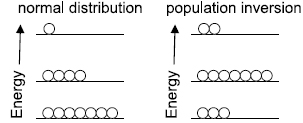
Image result for population inversion 

In general, an atom has more number of electrons in the ground state than in the higher energy levels. But after excitation of more number of electrons into the higher energy levels they settle down in the metastable for a longer time and that is known to be population inversion. In simple words, there will be more number of electrons in higher energy level than in lower energy levels.
As the Stimulated Emission is directly proportional to the number of electrons in the metastable state this process enhances and accelerates the process.
This population inversion can be achieved by pumping mechanisms or techniques. They are :
 1.Optical pumping
 2.Electrical discharge pumping 
 3.Chemical pumping
 4.Injection current pumping


Image result for pumping mechanism for population inversion


Einstein's coefficient (EC):

Let the number of electrons in the ground state is N1 and the excited state is N2.
Let energy density p(f)= nhf where n is the number of photons per unit volume at frequency f such that E2-E1=hf.
Absorption = B12*N1*p(f)
where B12 is EC of absorption.
Spontaneous Emission = A21*N2
where A21 is EC of spontaneous emission.
Stimulated emission = B21*N2*p(f)
where B21 is EC of stimulated emission.
Absorption is an upward transition and the other two are the downward transition processes of the electron.

Image result for einstein's coefficient in laser

In equilibrium both the transitions become equal i.e,
 B12*N1*p(f) = A21*N2 +  B21*N2*p(f)

 B12*N1*p(f) -  B21*N2*p(f) = A21*N2

 p(f) [ B12*N1 - B21*N2] = A21*N2

 p(f)*B21 [ N1 - N2] = A21*N2

 p(f) = (A21/B21)*(N2/N1-N2)

 p(f) = (A21/B21)*(1/(N1/N2)-1)
 
 From Maxwells Boltzmann distribution law :
N1/N2 = e^(E2-E1)/KT

p(f) = (A21/B21)*(1/(e^(E2-E1)/KT-1))

p(f) = (A21/B21)*(1/(e^(h(f))/KT-1))   ---------eqn1

By comparing  eqn1 with Plank's radiation formula we get :
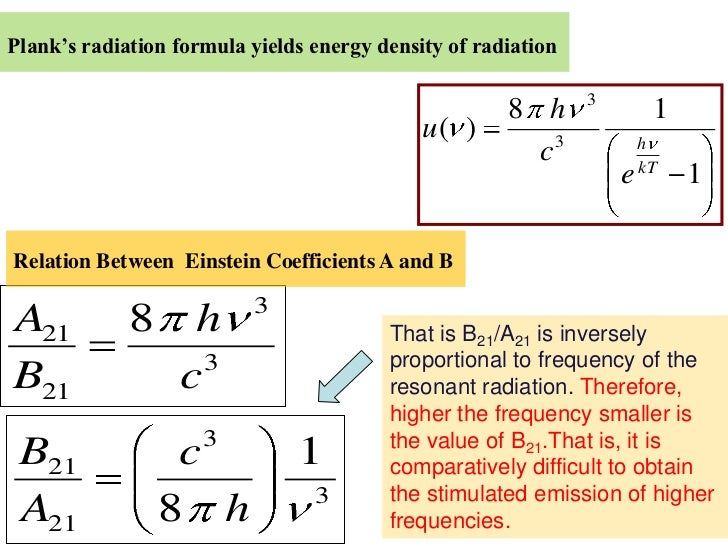
Image result for einstein's coefficient in laser

The above relations are referred to as Einstein's relations.

This is the theoretical explanation behind the lasers.

For more interesting and easy explanations of physics comment in the comment section.


Energy is liberated matter, matter is energy waiting to happen


Comments

Popular posts from this blog

What is the most easiest way to understand the interaction of subatomic particles?

The easiest way to represent and understand the interaction of subatomic particles is by using Feynman Diagrams. In theoretical physics, this method is used as a pictorial representation of the mathematical expressions of the behaviour of subatomic particles. This method was given by one of the famous scientist and lecturer  Richard Phillips  Feynman.   These diagrams are used to calculate the most difficult equations using diagrams. For example collision of two electrons: When two electrons collide they interact with each other and scatter apart. The interaction happens as follows: When two electrons are brought together they repel each other and move apart. This repulsion takes place due to the exchange of the gauge bosons. Gauge boson exchange is otherwise known as the exchange of particle or information. These are virtual particles. Here photons are the exchange particle involved. The photon released from one particle hits another electron and changes...

IS GRAVITATIONAL FORCE FICTITIOUS IN REALTY ?

Mr.Albert Einstein , one of the brilliant minds of the world, published the general theory of relativity in 1915. He gave a very different approach to the idea of gravity. The theory says that there is no such thing as gravitational force. Yes, the theory really proposed it. Then what causes this attraction? Its the metric of the space around it. The change in metric causes the objects to fall towards the heavier object. Here metric describes how an object moves in the space. The analogy is the space-time wrap is assumed to be a stiff cloth and the mass as balls. Now if we place the heavier ball, the cloth bends down due to its mass. If we leave a lighter ball into the cloth, the ball starts to orbit around the heavier massed ball as shown in the image below.     So when you drop something it doesn't fall due to any force of attraction but due to its natural motion of accelerating downwards towards the centre of the curved space-time of the E...

CHARACTERISTICS OF LASER

LASERs play a very vital role in many fields and industries. What makes it so special? It's characteristics. Lasers have: 1.High directionality 2.High monochromaticity 3.A high degree of coherence 4.High brightness So let's understand each one in detail. 1. High directionality: The lasers are made of active medium placed in between two reflecting resonator mirrors one which can partially reflect and the other which can fully reflect the light. Any photon travelling in a direction away from the cavity axis reflects away by the mirrors within a few reflections and is thus not allowed to propagate further, thus the beam drawn from the output mirror is highly parallel and directional. The degree of directionality is expressed as the divergence .  Minimum spot point:  The curvature of the mirror confines the light within the cavity and causes the beam to narrow down to a radius w o    and this is called a minimum spot point. The ...